
State of the Nation: The National Conversation Podcast Special
The National Conversation
How can the social care sector shape the national conversation?
With a new Prime Minister pledging to invest political capital in social care reform and the Casey Commission's National Conversation closer, there is growing optimism that England has a genuine opportunity to rethink its approach to social care.
In the latest episode of State of Our Nation, Kari Gerstheimer and Andy McCabe discuss how the sector can play an active role in shaping that conversation. Drawing on research from Social Care Future, The King's Fund, Bryony Shannon and Anat Shenker-Osorio, they explore what works—and what doesn't—when talking to the public about social care.
A once-in-a-generation opportunity
The episode begins by reflecting on the political moment. With renewed attention on social care and a commitment to a national conversation, there is an opportunity not simply to debate funding, but to reshape how the public understands the purpose of social care.
Rather than seeing reform as solely a policy challenge, Kari and Andy argue that it is also a communications challenge. If the sector wants lasting change, it needs to tell a more compelling story about why social care matters to everyone.
Language shapes how people think
One of the strongest themes throughout the discussion is the power of language.
Drawing on Bryony Shannon's work, Andy explains that changing individual words is not enough. What matters is changing the thinking behind those words.
Terms such as service user, placement or challenging behaviour can unintentionally reduce people to labels or imply that the problem lies with the individual rather than the system around them. Instead, conversations should start with people, relationships and the ordinary lives everyone wants to live.
As Andy reflects:
"Social care is a vehicle, not a destination."
Rather than talking about services, we should be talking about the lives those services make possible—working, raising families, spending time with friends, going to the gym, travelling or simply having choice over everyday life.
Framing social care through hope, not crisis
Kari also explores research by communications expert Anat Shenker-Osorio, whose work on human rights demonstrates how metaphors and framing influence the solutions people support.
The discussion highlights how social care is often described using crisis or battle metaphors—"fighting for care", "frontline services" or "the social care crisis". While familiar, these frames can encourage people to think defensively or focus solely on problems.
Instead, the podcast argues for language rooted in possibility.
Social care should be presented as something that enables people to flourish, strengthens communities and creates a fairer society—not simply as a service that responds when things go wrong.
Helping the public understand social care
The conversation also examines recent research from Ipsos and The King's Fund, which found that many people still do not understand what social care is or how it is funded.
That presents both a challenge and an opportunity.
The research suggests that people often engage more readily when social care is discussed alongside healthcare. However, Kari and Andy caution against allowing social care to become defined solely by its relationship with the NHS.
Yes, good social care helps hospitals function more effectively—but its real purpose is much broader.
As the discussion makes clear, social care exists to enable people to live the lives they choose, maintain relationships, contribute to their communities and pursue their ambitions. Health is part of that story, but it is not the whole story.
Rights, fairness and the future
The episode concludes by reflecting on the Care Act and the importance of ensuring that people's rights are not only written into legislation but realised in practice.
Throughout the discussion, Kari and Andy return to a simple but powerful message: social care is not something for "other people". It is something that almost all of us will rely on ourselves or for someone we love at some point in our lives.
If the National Conversation is to succeed, it needs to move beyond talking about systems and services and instead focus on what people value most—independence, relationships, contribution, dignity and the freedom to live a good life.
The language we choose will play a crucial role in determining whether that vision becomes reality.
Research discussed in this episode
Social Care Future – A Growing Brighter Future Together and framing resources: https://socialcarefuture.org.uk/
The King's Fund & Ipsos – Not My Priority: How the Public Sees Social Care and What Can Be Done About It: https://www.kingsfund.org.uk/insight-and-analysis/reports/not-my-priority
Bryony Shannon – Rewriting Social Care: Challenging and Changing Language and Practice for a Better, Brighter Future https://www.amazon.co.uk/Rewriting-Social-Care-Changing-Language/dp/1805011774
Anat Shenker-Osorio – A Brilliant Way of Living Our Lives: How to Talk About Human Rights: https://frameworksinstitute.org/publication/a-brilliant-way-of-living-our-lives/
You can find the series on Spotify , Apple Podcasts, or listen to each episode on our website. Just click on the link to the right.
Find out more about Social Care Future here
Use AccessAva, our online digital service to find free social care resources and legal support.
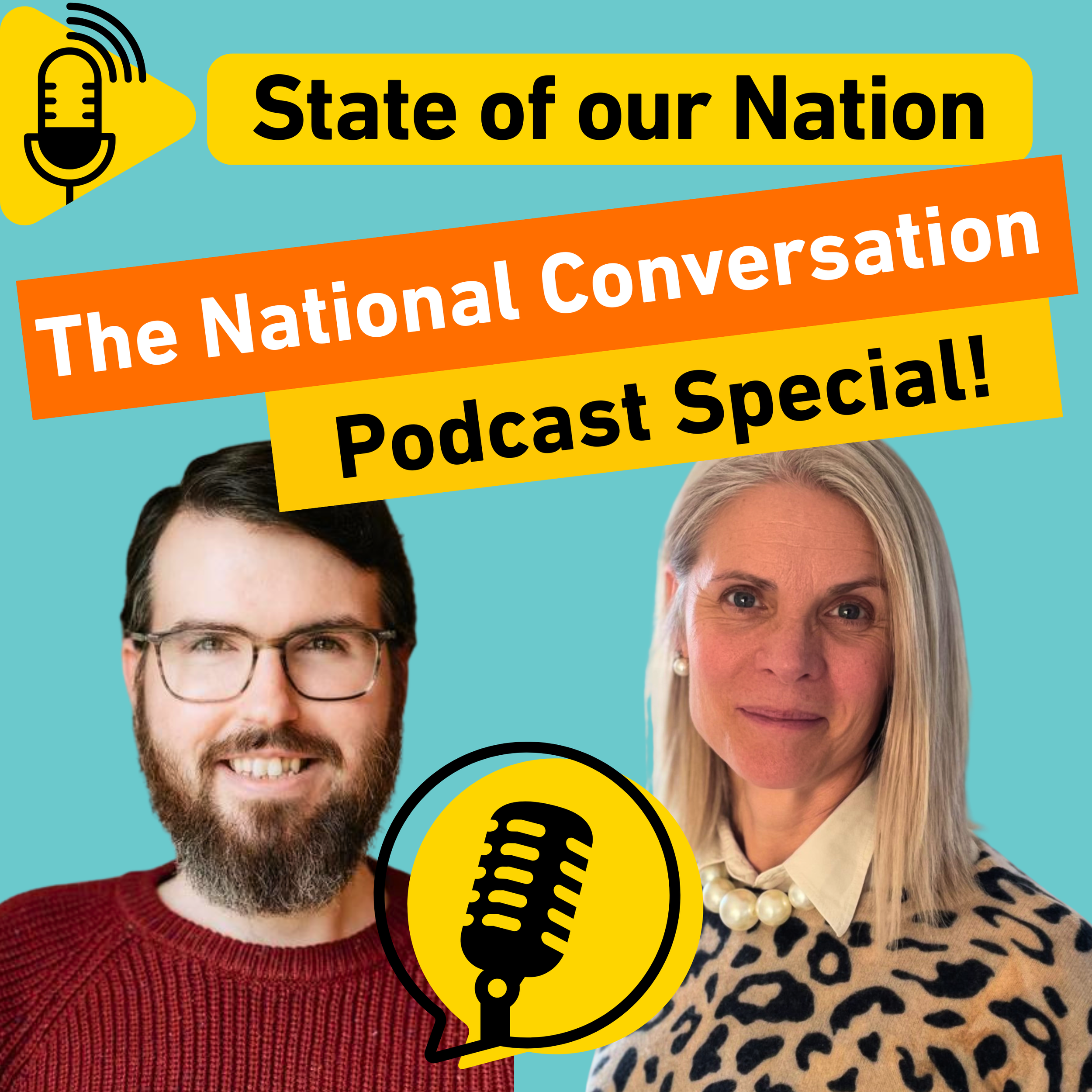
Promo graphic of Kari and Andy for State of our Nation Podcast
Listen on Spotify.
Listen on Apple Podcasts.