

The Helplines Collaboration
Mapping the National Picture
For the past five years, Access Social Care have led a unique data-sharing partnership to better understand the challenges people face within the social care system. By combining information from our own legal helplines with data from eight other organisations, we have created a comprehensive picture of the recurring themes and systemic barriers reflected in social care advice provision. We publish this data in our State of the Nation Reports.
Why?
We are on a mission to connect the rich knowledge already held by advice organisations into a powerful evidence base for change.
The evidence gap
Social care advice is delivered by hundreds of organisations across England. Historically, each one saw only its own slice of demand. While individual helplines could identify what their callers were concerned about, no one could say for certain whether those issues reflected trends within one service, one audience, or a wider national shift.
We set out to fix this. By combining our evidence, we have created a national dataset that strengthens every organisation’s voice.
How it works: a shared language
The foundation of this project is a shared taxonomy of 14 Universal Themes.
This is our common language for categorising social care queries, grounded in the legal duties local authorities hold under the Care Act 2014.
These themes cover essential areas of life, including:
Social care assessments and support planning
Safeguarding and rights
Direct payments and funding
Unpaid carer support and mental capacity
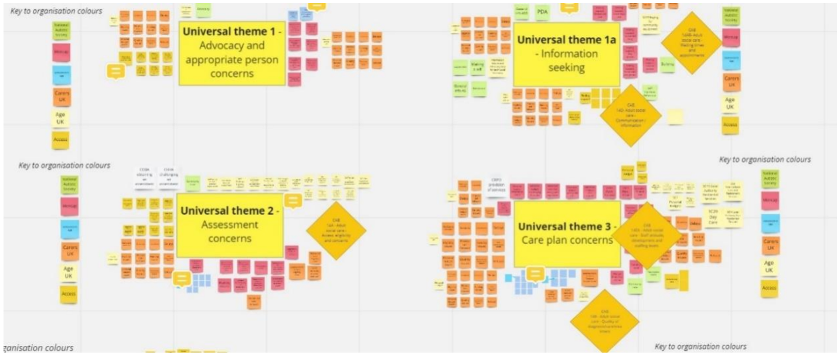
Universal Themes workshop - each organisation’s topics mapped to shared themes in a collaborative Miro session
Built with our partners
This framework was built through collaboration. In 2020, data leads from across the sector shaped these themes together in a real-time visual workshop.
In the workshop it became evident that each partner collected data in different ways. Instead of changing the ways we worked as individual organisations, we focused on creating processes that harmonised the information. We studied each partner’s internal methods and built bridges between their data and the shared framework. We filter out non-social care data and exclude anything that does not map accurately to a Universal Theme.
The result is a clean, aggregated national dataset that protects individual privacy while providing a clear picture of sector-wide demand.
Want to see the technical detail? You can find our full ETL strategy flowchart in the State of the Nation report appendix. It outlines our entire pipeline, including quality control and mapping from raw data to final analysis.
Who is involved
We are proud to collaborate with a broad range of national organisations:
Age UK | Carers UK | Citizens Advice | Ealing Advice Service | Independent Age | Mencap | RNIB | Scope
Partner data is never published at the source level—we only share findings in aggregate to ensure total confidentiality.

The collaborating partners.
What the data reveals
Our data shows that the need for expert social care advice is growing. Findings from our 2025 State of the Nation report include:
7.5% increase in the number of people seeking social care advice through helplines.
45.6% increase in safeguarding concerns raised across the sector.
Sustained pressure regarding direct payments, support for unpaid carers, and the assessment process.
These insights are only possible because eight organisations are looking at the same challenges together. You’ll find the full report for 2025 and each of the previous dataset which are published as the ‘State of the Nation’ reports at the bottom of this page.
Strength in numbers. Clarity through data.
Too often, the experiences of people navigating social care are not fully reflected in policy decisions. Every data point from this collaboration is a direct counter to that. We believe that no organisation should have to evidence systemic injustice alone. By pooling our data, we transform isolated insights into a national movement for legal rights. Your data doesn't just fill a gap; it strengthens our collective ability to challenge unfairness and advocate for a social care system that works for everyone.
Influence the future through collaboration.
Please get in touch with us to discuss how we can harmonise your organisation’s insights with the national dataset and amplify our impact together.
Key findings from the 2025 report
45.6%
increase in safeguarding concerns
16.6%
increase in advice provision identifying the need for specialist legal advice
10.7%
rise in general social care advice queries within the information seeking category
8.6%
increase in direct payment queries
7.5%
increase in people receiving advice about social care through helplines
7.3%
rise in unpaid carer queries
Find insights from the helplines collaboration in our annual State of the Nation reports
2025
2024
2023
2022
2021
Stay up to date with our newsletter
Sign up for our newsletter to hear inspiring success stories, updates on our campaigns, and insights from our latest research.