
From surviving to thriving: the key themes from Series 4 of State of Our Nation
What does it really mean to live a good life? And what would social care look like if it were designed around people, rather than the systems they have to navigate?
These questions sit at the heart of Series 4 of State of Our Nation, our podcast exploring the future of social care and the changes needed to help everyone live with dignity, choice and control.
Across four conversations with comedian Ria Lina, journalist Sonia Sodha, disability consultant Will Pike, and writer and disability rights activist Penny Pepper, one message comes through clearly: social care should be about enabling people to live, not simply keeping them safe.
Each guest brings a different perspective, but together their experiences challenge us to think differently about disability, independence, inclusion and the value society places on care.
Here are five key themes from the series.
1. Social care should enable people to live full lives
A recurring message throughout the series is that social care must be about much more than meeting basic needs.
Good support is not simply about helping someone get through the day. It should enable people to build relationships, pursue interests, work, contribute to their communities and make decisions about their own lives.
In her conversation with Kari Gerstheimer, Sonia Sodha challenges us to think about the difference between being kept alive and living a life. Social care should make ordinary, meaningful experiences possible, rather than focusing primarily on managing risk or decline.
Penny Pepper brings this into focus through her own experiences of support. When care is reduced to a list of tasks, the things that make life fulfilling — creativity, relationships, independence and choice — can be pushed aside.
The question is not simply whether someone’s basic needs are being met, but whether they have the support they need to live the life they want.
2. We need to remove barriers, not expect people to fit in
Ria Lina and Will Pike challenge us to look beyond individual circumstances and consider how society itself can create disability and exclusion.
Ria explores the social model of disability: the idea that people are disabled not simply by their impairments, but by the physical, social and institutional barriers around them. A building without step-free access, a service that fails to accommodate neurodivergent people, or a system that restricts someone’s choices can all prevent people from participating fully in society.
Will takes this further through the concept of universal design. Rather than treating accessibility as an adjustment that needs to be made for people, he asks why we do not design homes and environments to be accessible from the outset.
Wider doorways and step-free access, for example, can benefit wheelchair users, older people, parents with prams and anyone whose circumstances change over time.
Inclusion should not depend on people having to fight for adjustments after barriers have already been created. Accessibility needs to be built into the way we design our homes, services and communities.
3. Choice, control and autonomy must be at the heart of support
Independence is often treated as the ultimate goal of social care. But as Will Pike explores, being independent is not the same as having control over your life.
People may need substantial or ongoing support to do the things that matter to them. That should not mean losing the ability to make decisions, take risks, maintain relationships or choose how to spend their time.
Penny Pepper describes how inflexible support arrangements can affect everyday decisions and personal relationships. When support is organised around rigid systems rather than individual lives, people can find themselves having to fit their lives around the service they receive.
Ria’s conversation also highlights the importance of involving people in the design of services from the very beginning. Genuine co-production means listening to people who draw on care and support before decisions are made, rather than asking for their views once the plans are already in place.
Together, these conversations point towards a different approach: support should give people greater control, not impose unnecessary restrictions. It should respond to what matters to each individual, recognising that people have different needs, ambitions and ideas of what a good life looks like.
4. We must recognise the value and skill of care work
A better social care system depends on recognising the people who provide care and support.
Across the series, guests challenge the tendency to undervalue care work, despite the skills, judgement and human connection it requires.
Sonia Sodha highlights how caring work has historically been associated with women’s work and, as a result, has often been underpaid and undervalued. She argues that we need to recognise care as skilled, meaningful work and be honest about the resources required to deliver it well.
Will Pike reinforces this point, emphasising that people with complex needs require skilled support from people who understand their circumstances. Having support available is not enough if it is not the right support.
Ria Lina also draws attention to the wider lack of recognition afforded to care workers and other essential workers.
Valuing care means more than expressing gratitude. It means recognising professional skills, providing appropriate pay and working conditions, and creating an environment in which care workers can build meaningful careers.
It also means recognising that the quality of support people receive is inseparable from the conditions in which care workers operate.
5. Social care is a shared responsibility — and a question of rights
The final theme running through the series is the need to rethink social care as a fundamental part of society, rather than a marginal service for a particular group of people.
Sonia Sodha raises difficult but important questions about how care should be funded and how responsibility can be shared fairly. Social care can affect any of us, whether through disability, illness, ageing or caring for someone we love. A fairer system must consider how support is funded and allocated, and how people with different needs and financial circumstances can access it.
Penny Pepper brings the discussion back to rights and the importance of understanding what people are entitled to. Knowing about legislation such as the Care Act and Equality Act can help people question decisions that do not reflect their rights or wellbeing. But people should not have to become expert campaigners simply to secure the support they need.
Ria’s conversation also reminds us that social care supports people throughout their lives, including working-age disabled people and neurodivergent people who are too often missing from public discussions.
Social care is not just about responding when something goes wrong. It is part of the infrastructure that enables people to participate in society, maintain relationships and live with dignity.
Recognising this means moving beyond short-term fixes and asking what kind of society we want to build.
What comes next?
Series 4 of State of Our Nation brings together four distinct voices, but their conversations share a clear ambition: a society in which disabled people and everyone who draws on social care can live full lives, exercise choice and control, and be valued as equal members of their communities.
Achieving that vision requires more than changes to individual services. It means challenging the assumptions that shape social care, designing accessible environments, listening to experience, valuing the workforce and building a system around what people need to live well.
Most importantly, it means recognising that social care is about people — their relationships, aspirations, rights and everyday lives.
The challenge now is to turn these conversations into action.
Listen to Series 4 of State of Our Nation and join us in imagining what social care could look like if we designed it around all of us.
You can find the series on Spotify , Apple Podcasts, or listen to each episode on our website. Just click on the link to the right.
Find out more about Social Care Future here
For information on The Big Conversation on Care
Use AccessAva, our online digital service to find free social care resources and legal support.
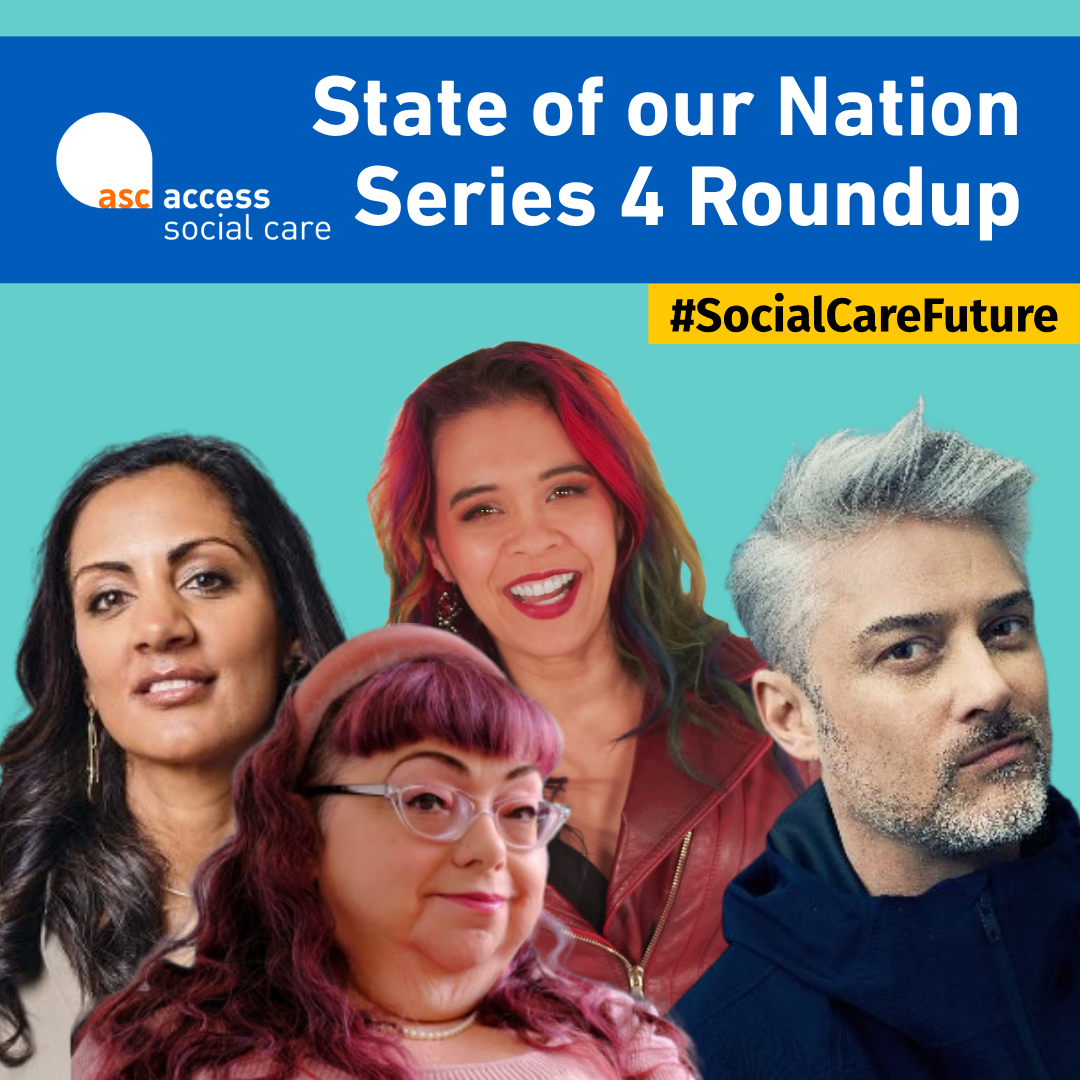
Podcast graphic, photo of Ria Lina, Sonia Sodha, Penny Pepper and Will Pike smiling.
Listen on Spotify.
Listen on Apple Podcasts.