
Fighting the Paper Formula: Lizzie’s Journey for True Social Care
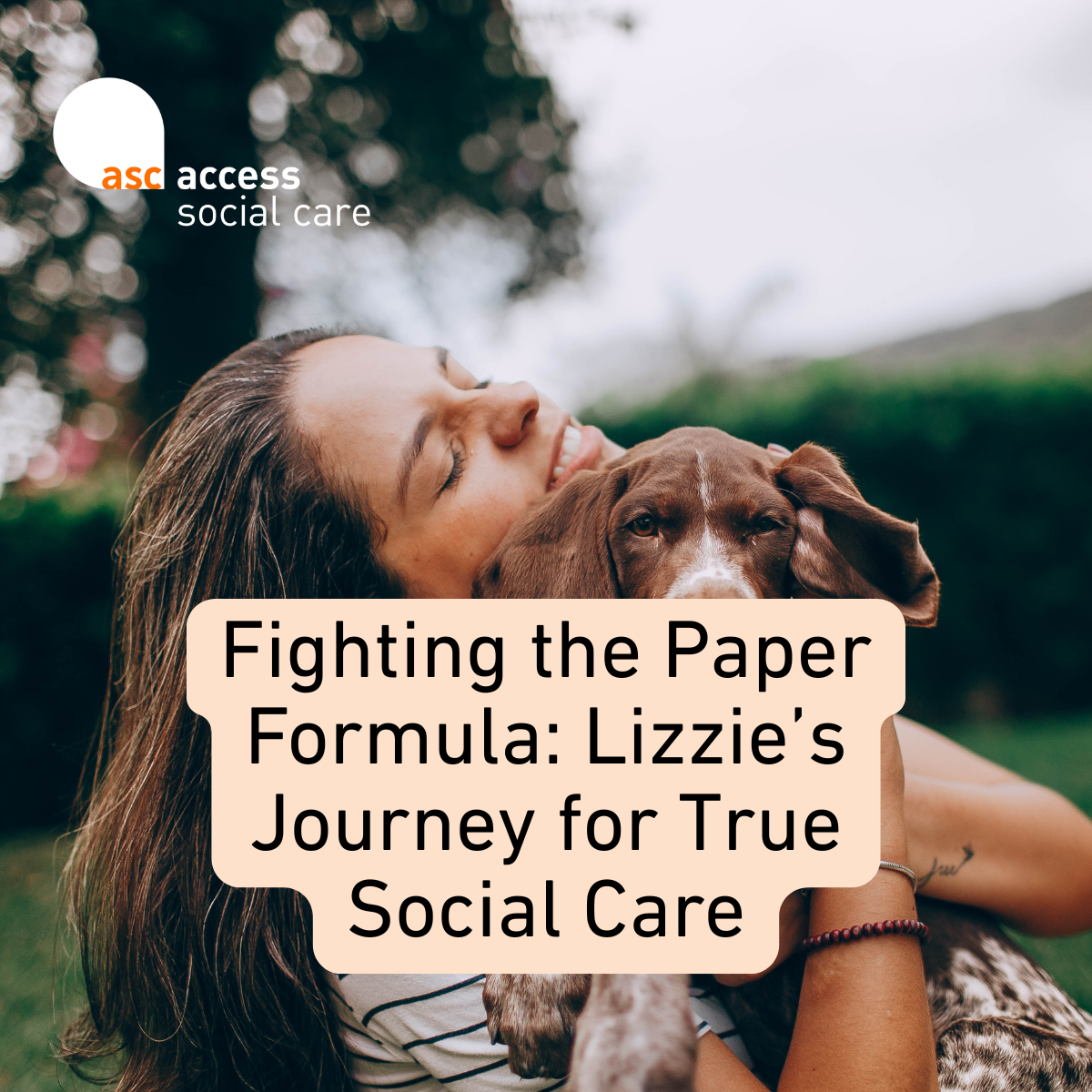
Photo of women hugging a dog, with the title ‘Fighting the paper formula: Lizzie’s journey for true social care.
We must demand a social care system that sees the individual, acknowledges specialist care and support needs, and provides funding based on actual human needs and not rigid local authority balance sheets.
This is the story of Lizzie, a woman in her late 30s with a rare chromosome disorder, and her family’s decades long battle against a rigid, uncaring bureaucracy. It is a journey marked by systemic barriers, paper formulas that ignore human lives, and the turning point that finally brought them hope.
The Reality of 24-Hour Care
Lizzie lives at home with her mother, Karen, and her stepfather, Kevin. Alongside Lizzie’s elderly grandmother, they form a tight, exhausted network of unpaid carers. Because of her rare chromosome disorder, Lizzie physically and cognitively functions at the level of a toddler.
"Caring for Lizzie is like caring for a toddler who would be unsafe without constant supervision... she does not have the understanding of how to cross a road safely; she would not change her clothes, eat or go to bed unless she is reminded to."
Trapped in a Fault-Finding System
Lizzie’s condition was present at birth, but it took nine years to get a diagnosis. During those early years, instead of receiving support, Karen was met with invasive questioning from medical professionals:
"The appointments were exhausting, incredibly intrusive and uncaring... they would ask, 'During pregnancy, did you smoke, did you drink, did you take drugs?' My wife was made to feel like Lizzie’s condition was her fault."
When Lizzie reached school age, social care support was stripped back to the bare minimum. The only respite Karen received in her daily 24-hour period was the school taxi ride to and from the specialist school and the time at school itself.
Thrown into a Cold and Costly Court Room
When Lizzie turned 16, the family had to fight the local authority at a tribunal just to keep her in specialist education. Unprepared and intimidated, they were forced into a legal system not designed for families and into environments that were both unwelcome and not psychologically informed.
"The hearing was held at a hotel in a large room—empty, echoing and highly intimidating... We were not allowed to speak even though the case was about our own child—only our lawyer could speak on our behalf.
We know we would have lost if we hadn't been supported by the lawyer."
They won the tribunal, securing two more years of education at a specialist post 16 unit.
The Rise and Fall of Managed Care
When school ended, the transition to adult social care began. For over a decade, a local commissioned care company worked well. The family co-interviewed candidates, establishing a dedicated, consistent four-person team that knew Lizzie's communication needs and behavioural triggers.
When a larger national organisation bought out the local care provider, carers were overburdened with new changes and paperwork requirements. The team were replaced with an ever-changing, rotating door of staff - some with communication and cultural barriers to understanding Lizzie’s needs. They were never there long enough to build a safe and trusting relationship with Lizzie, which led to Lizzie becoming distressed often and the care staff did not know how to de-escalate these situations.
"Lizzie benefits from and needs her carers to be ‘on her wavelength’, for example, to kneel down to create eye contact with Lizzie and hug her if she displays distress – this really helps her to feel safe and calm. Some carers from a different culture stay standing... it does not come naturally for them to get close to the person they support, but it is Lizzie’s culture; it is Lizzie’s needs that need to be met."
This type of provision meant that, instead of being able to take time out for other daily responsibilities, rest and recuperation, the family – even though there was a carer there for Lizzie, had be available to support with communication and reassurance. A lot of time was spent explaining to the carers how to understand, approach and support Lizzie in ways that she would not be triggered into distress.
The Danger of Balance Sheets
By 2018, long term planning for Lizzie’s future needed to be in place before a crisis point was reached requiring an emergency placement and the family asked the local authority for an appropriate 24/7 residential placement. The council’s response was a typical and dangerous "paper formula" exercise: Lizzie was offered a room in a shared house with overnight sleep-in staff and just three hours of daily 1:1 support. When the family protested, a social care professional attempted to drop Lizzie’s case entirely. When COVID-19 hit, the family were left to cope alone.
Post-pandemic, the local authority used the family's own devotion against them - because the family had kept Lizzie safe, the system scored her as having ‘minimal needs.
"They were refusing to listen to us. We were told, 'She can dress herself' -yes, she can, but only with prompting; 'She can wash herself', - yes, she can, but she needs prompting’; ‘She’s not that bad.'
The Turning Point: Access Social Care
Karen had been attending a local carers support group when a member of the Communities team from Access Social Care Charity visited to inform carers of their rights and the rights of the people they care for.
Deeply distrustful of a system that had failed them for decades, but in desperate need of support, the family later reached out to Access Social Care. They were introduced to Danny, a legal caseworker who looked past the balance sheets to the human beings involved. Danny drafted a precise, legally grounded letter to the local authority.
The local authority immediately assigned an "Autism Champion" social worker who listened, and scrapped the unsafe plan. They approved a brand-new care package starting with 1:1 support.
From Surviving to Navigating
Today, the family is actively looking for the right, safe and calm placement for Lizzie.
For the first time in nearly 40 years, they are looking forward to rest, recuperation, and peace of mind, so that the time with Lizzie can be enjoyed by the whole family. The family need to be confident that when Lizzie is being cared for by her supporting care team, her needs are being met, and she is also being motivated to reach her full potential. Lizzie needs to be as active as her disability allows and to be part of her community while leading a fulfilled life.
Empowered by this victory, Kevin decided to use his lived experience to help others. For the past year, he has worked as a Peer Navigator alongside Access Social Care, using AccessAva to inform other unpaid carers of their rights and how to navigate the social care system.
AccessAva is a 24/7, free online service that gives you clear, personalised guidance about your social care rights, without the confusing jargon. Developed by specialist lawyers, AccessAva listens to you and provides practical next steps – giving you peace of mind and a clear path forward when you need it most.
Through AccessAva, carers can cut through bureaucratic ignorance and generate their own legal template letters to fight back against unfair local authority decisions, ensuring that human lives are never reduced to numbers on a spreadsheet again. https://www.accessava.org.uk
Sharon Sharman – Peer Navigator Coordinator, Access Social Care on behalf of Kevin.