
Unlocking Accountability: A radical approach to Data
This article appeared in the MJ in July 2025 with the heading ‘Triangulating Data’.
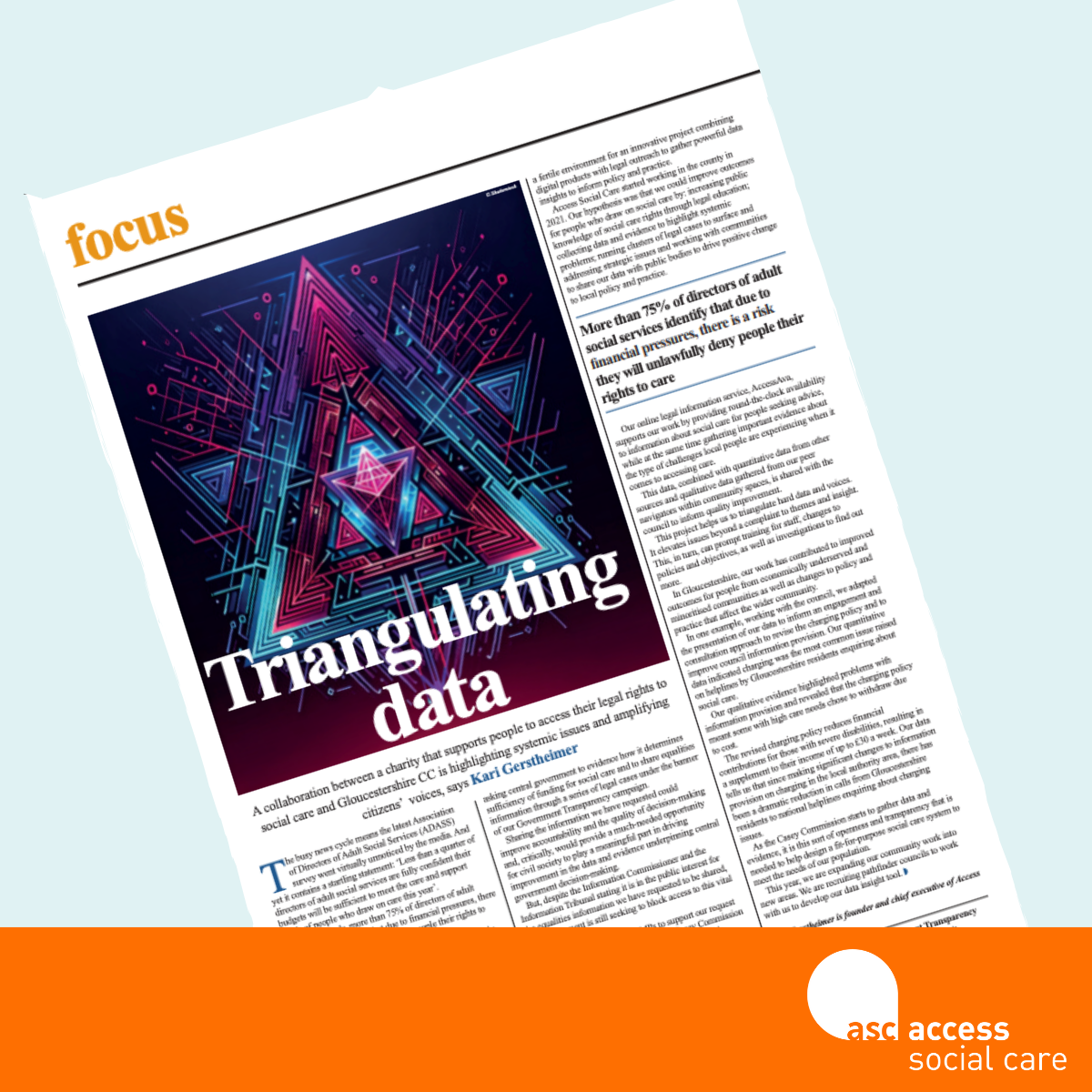
The article in the MJ
Kari Gerstheimer Founder and CEO of Access Social Care, a charity that supports people to access their legal rights to social care.
The busy news cycle means the latest Association of Directors of Adult Social Services (ADASS) survey went virtually unnoticed by the media. And yet it contains a startling figure.
‘Less than a quarter of Directors of adult social services are fully confident their budgets will be sufficient to meet the care and support needs of people who draw on care this year’.
In other words, over 75% of DASSs identify a risk they will unlawfully deny people their rights to care due to financial pressures. Our own report the ‘State of the Nation’ shows a deeply troubling 45% increase in safeguarding concerns across national helplines in the past 12 months. These trends are reflected in our caseload. Every day our lawyers see people in desperate and dangerous situations because of a lack of care. Our direct intervention makes sure people get the social care they have a right to – we have a 98% success rate with our cases. But we can’t reach everyone, and we shouldn’t have to.
Despite this evidence, along with Health Foundation estimates of an annual funding gap of £8.4 billion, central government asserts that social care is adequately funded. In order to address this reality gap, we have been asking central government to evidence how they determine sufficiency of funding for social care and to share equalities information through a series of legal cases under the banner of our Government Transparency campaign. Sharing the information we have requested could improve accountability and the quality of decision making and critically would provide a much-needed opportunity for civil society to play a meaningful part in driving improvement in the data and evidence underpinning central government decision making.
But, despite the Information Commissioner and the Information Tribunal holding it is in the public interest for the equalities information we have requested to be shared, the Labour Government is still seeking to block access to this vital information. We are currently writing to MPs to support our request that this vital information is shared with the Casey Commission at the very least, so that the Commission tasked with shaping the future of adult social care has a clear picture of the current landscape.
Pioneering Transparency: Redefining Social Care in Gloucestershire
Against this backdrop, our work in Gloucestershire feels refreshing and radical.
Our experience has been that leaders in the council are taking an evidence-based approach to transformation. By fostering a culture of openness and curiosity it has provided a fertile environment for an innovative project combining digital products with legal outreach to gather powerful data insights to inform policy and practice. Access Social Care started working in the county in 2021. Our hypothesis before we started this work was that: we could improve outcomes for people who draw on social care (and particularly for people from underserved communities) by increasing public knowledge of social care rights through legal education; collecting data and evidence to highlight systemic problems; running clusters of legal cases to surface and address strategic issues; and working with communities to share our data with public bodies to drive positive change to local policy and practice.
Our online legal information service, AccessAva, supports our work, by providing round the clock access to information about social care to people seeking advice, whilst at the same time gathering important evidence about the type of challenges local people are experiencing when it comes to accessing care. This data, combined with quantitative data from other sources, and qualitative data gathered from our peer navigators within community spaces, is shared with the council to inform quality improvement.
This project helps us to triangulate hard data and voices, it elevates issues beyond a complaint to themes and insight. This in turn can prompt training for staff, changes to policies and objectives as well as investigations to find out more.
Real-world impact: How our work drove policy change
In Gloucestershire, our work has contributed to improved outcomes for people from economically underserved and minoritised communities as well as changes to policy and practice which affect the wider community.
In one example, working with the Council, we adapted the presentation of our data to inform an engagement and consultation approach to revise the charging policy, and to improve council information provision. Our quantitative data indicated charging was the most common issue raised on helplines by Gloucestershire residents enquiring about social care. Our qualitative evidence highlighted problems with information provision and revealed the charging policy meant some with high care needs chose to withdraw due to cost. The revised charging policy reduces financial contributions for those with severe disabilities, resulting in a supplement to their income of up to £30 a week. Our data tells us, since making significant changes to information provision on charging in the local authority area, there has been a dramatic reduction in calls from Gloucestershire residents into national helplines enquiring about charging issues.
As The Casey Commission starts to gather data and evidence, it is this sort of openness and transparency that is needed to help design a social care system that is fit for purpose and meets the needs of our population.
This year we are expanding our communities work into new areas. We are recruiting pathfinder councils to work with us to develop our data insight tool. Find out more about our Government Transparency campaign, our digital service AccessAva, and our work in Gloucestershire on our website here. https://www.accesscharity.org.uk/
